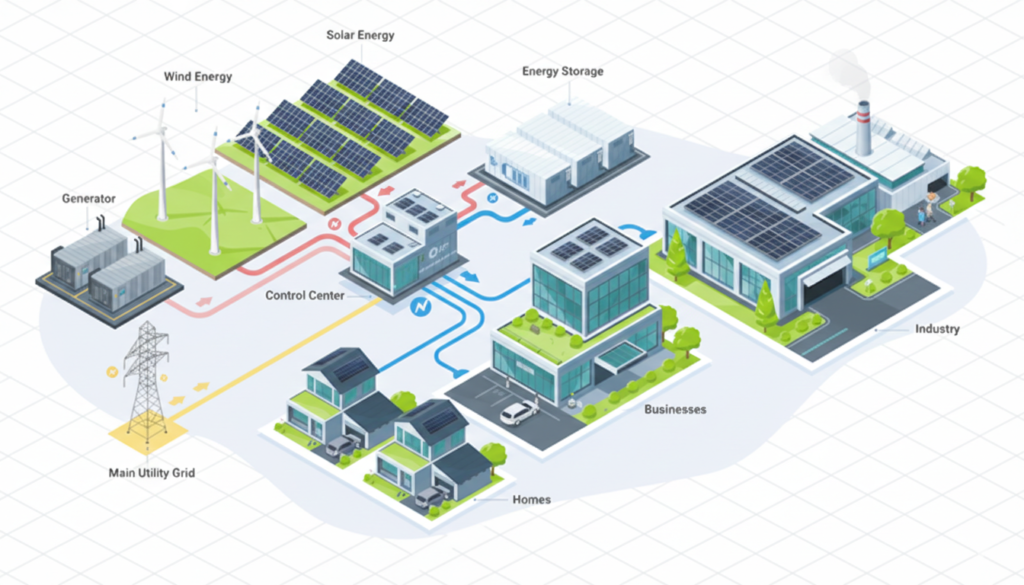
What is a Microgrid?
Think of a microgrid as a “neighborhood for energy.” It is a localized collection of power sources—diesel generators, solar arrays, battery storage, and perhaps wind or hydro turbines—that work together. While these assets usually stay connected to the main utility grid, they are designed for “islanding.” When a storm or wildfire disrupts the main lines, the microgrid detaches, creating an island of stable power separate from the chaos on the rest of the system.
The Leaning Tower of Centralized Control
Most microgrids today rely on a centralized control hub (as shown in the diagram). In this model, every piece of equipment reports to a single “brain”—often a building full of monitors or a single PLC in a metal cabinet. To make this brain work, an engineer must attempt to predict every possible scenario the grid might face. The result is a teetering tower of if/then statements:
- If the sun is setting and the battery is at low charge, then start the generator.
- If the ge nerator fails to start and the load is high, then turn off the lights.
While this can be effective most of the time, eventually the real world throws you a curve ball. And when these systems suddenly don’t know what to do, they can introduce their own problems – oscillating, fighting themselves, or just giving up and shutting down.
A Holler and a Handshake
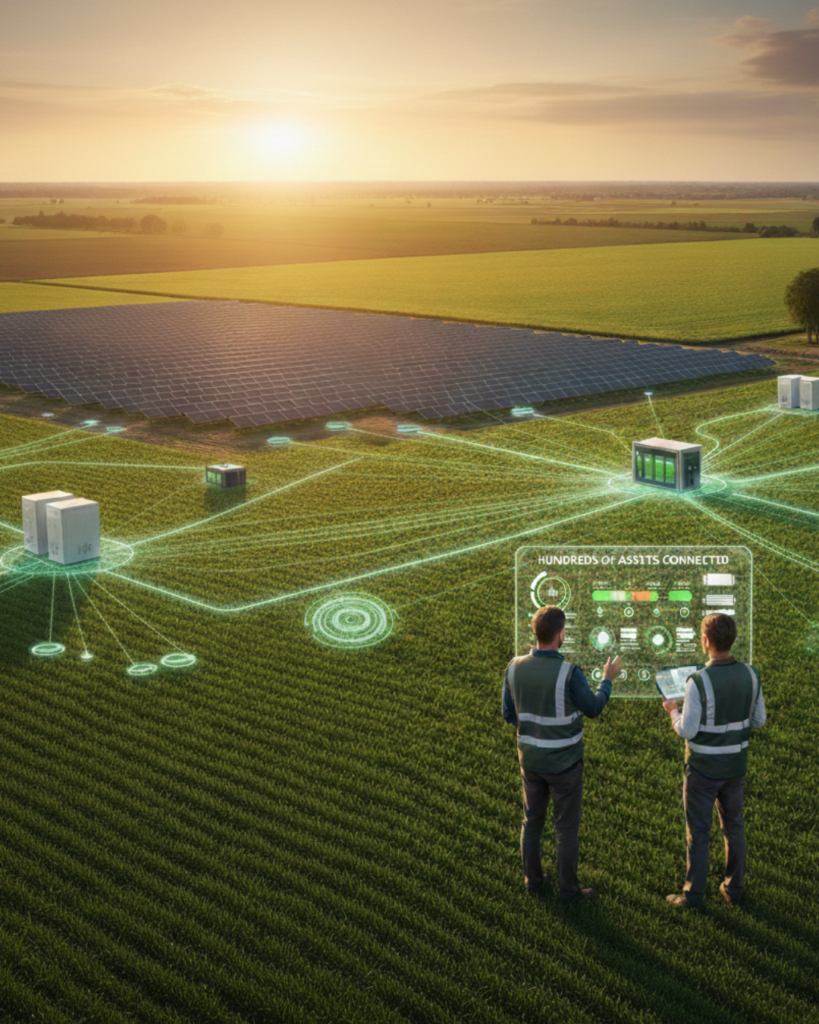
Entwise replaces this predefined script with distributed intelligence. Instead of one giant, complex brain trying to do everything, we give every asset (each solar inverter, battery, or generator) its own simple, neural-network-based “micro-brain.” This is where we bring the promise of AI to bear on real world problems.
These AI controllers don’t follow a rigid script. They are trained to understand the goals of the system. By talking to their immediate neighbors, they work out complex solutions on the fly—reacting to reality rather than a pre-programmed guess. If an asset is lost or a new one is added, the “collective” doesn’t need to be reprogrammed. The remaining assets simply “shake hands” and redistribute the workload based on the new reality.
This means that the Entwise system is highly scalable. The same underlying communal approach applies whether you are:
- Linking two small generators in a remote village to share the load, or
- Managing hundreds of diverse assets across miles of farmland.
By replacing the “leaning tower” of fragile scripts with a “handshake” of distributed intelligence, Entwise isn’t just making microgrids easier to build; we are making them harder to break. Whether you are powering a single remote clinic or an entire municipal district, the intelligence stays the same: simple, collaborative, and scalable.
Let’s Start the Conversation
We realize that shifting from a central controller to distributed intelligence raises a lot of questions.
- How do the AI brains learn how the system works?
- How do we ensure the reliability of these AI brains?
- How do the brains actually talk to each other?
- How do we ensure security in a peer-to-peer network?
- What does this look like for your specific set of assets?
We don’t expect you to take this journey alone. Like the assets in our grid, we believe in the power of a good handshake. If you’re curious about how this “neighborhood for energy” can work for you, we invite you to reach out. Let’s explore the possibilities of a smarter, more resilient future together.